A Small Child’s Parents Guide
About six months ago we attended an open day for children from five to seven years old at the Royal Conservatoire in The Hague. We took the train from Leiden to The Hague Central Station and walked a few minutes to the Amare building which houses the conservatoire. When I used to teach at Leiden University campus The Hague, I watched the building rise from the classroom window. I had always been very curious about it, mostly because the construction looked impressive, so when I saw the conservatoire’s open day, I took the opportunity to visit.
The open day took place on the fourth floor, with several large rooms reserved for the occasion. We first entered the drum room. The music was upbeat, the teachers warm, and while there were many moving parts, everything looked harmonious and we immediately felt part of it. It was like walking into a music box. My son was trying to play the marimba when a little girl, around eight years old, suddenly materialized next to him and showed him the basics. I was captivated: the room, the music, the atmosphere, the perfectly sized small instruments, the little helpers. When my son was ready to move on, I did not want to leave.
We moved through rooms with tiny harps, flutes, violins, cellos. He was curious, but usually after ten minutes: done. As we walked the corridor I asked my husband about accordion, I had seen it on the website. A family passing by heard me and pointed us to the end of the hall.
There were about ten families waiting for their turn. The room was large, with tall glass windows overlooking De Nieuwe Kerk. First we sat on the floor like most people, except for two adults sitting on plastic chairs close to the teacher. I paid attention to the people who came after us in order to keep track of our turn, a sacrosanct ritual in the Netherlands. It really was taking a long time. Eventually the people in the plastic chairs left and I sat on one, my son dragged himself along the floor stretching out towards me, reaching for my hand in a desperate plea for rescue from boredom. He sat on my lap and I asked him if he wanted to leave, I was ready to go. But he did not want to leave which honestly surprised me. At that point we had lost sight of dad, who was last seen somewhere in the back among the sea of desperate parents.
Once on my lap, he stayed very close to me, caressing my face, playing staring contests. He was soothing me as much as I was soothing him. I remembered a time when he was about three years old and we went to the World Museum in Leiden, and how he had done the same thing while we were waiting in line to buy lunch. I don’t remember what the occasion was, but the museum was completely packed. We were in line for a very, very long time, and I carried him the entire time, afraid he would be crushed in the crowd. He was surprisingly calm, enjoying being so close to mama’s face with his little sticky hands and sudden savage kisses. It was much the same at the Conservatoire: close, warm, cuddly. He smelled like strawberries and candy.
Eventually it was our turn. With each child we had observed exactly the same sequence: a child would sit on the tiny stool, the teacher would help them strap on the accordion. Then she would show them how to make some sounds and how to use some of the buttons, and she would invite them to play. All the children were, understandably, very cautious and contained during their interaction.
And then came my son’s turn. I was expecting more of the same but he was, sparkly, exuberant even. It was like the lights suddenly went on and the performance began. He was smiling and enjoying himself so much. He tried to follow the teacher’s instructions and it just looked like a good time. I did not expect that at all, particularly after seeing the previous children.
In the following weeks we received all the information for the test day. We hadn’t seriously considered taking him to the test day, but after his enthusiasm during the open day, I decided to read about the programme to make an informed decision. I was pleasantly surprised by what I found. The instruction was divided into two parts, one for instrument learning, and one called Broad Musical Development (BMO in Dutch) where audiation, rhythm, and pitch relationships are learned through singing and movement games. Parents are expected to join the musical games, and be present during the instrument lessons.
Learning music at that age is compared to learning a new language. The more I read, the more I liked it. Their approach seemed well aligned with our own parenting style, and the relational approach is something I recognized and warmly welcomed. So I put the date on my calendar.
We arrived on test day and soon after the accordion teacher came to greet us, she told my son she remembered him from the open day, and we walked through a long maze of empty rooms. It was extremely silent, I was wearing an anklet with bells and they were all we could hear, with each step I deeply regretted my choice of jewelry. I even wondered if I should walk “rhythmically” to make a good impression. Eventually we reached a room.
The room looked smaller than it was due to a large piano taking over almost half the space. On the remaining space there were two chairs and a small children’s stool, right in front of the stool there was a very small but extremely beautiful blue accordion. In my memory the accordion is almost incandescent. Erica picked up her accordion, and I helped my son strap his on. And the music began.
I had no expectations, so what I encountered was completely unexpected. My son’s command of the instrument came as a surprise, he handled it with curiosity but also ease, it almost looked like familiarity. After he got a hold of the instrument, he mentally left the room and was elsewhere immersed in curiosity, discovery, and what looked like recognition. Even Erica made a comment about how intensely curious and engaged he was.
After some minutes, Erica moved on with what I presume were the items to be tested. My own attention during the test, and subsequent recollection of events, is highly intermittent. My awareness moved like a photon: present one moment, gone the next, sometimes a wave, sometimes a particle, on and off throughout the test. From my perspective, there was a lot happening, much more than what was apparent.
At some point, she tested his ear, she asked my son to recognize whether the tone she was playing was baby elephant or grandpa elephant. He seemed to be doing well, then suddenly, in a truly recognizable five year old fashion, he made up a story where grandpa elephant went away to run an errand and had been replaced by daddy elephant, so now he was identifying whether the tone was baby or daddy elephant. Erica, in order to make sure she was clear on what he was saying, repeated my son’s amendment of the story, my son confirmed, they both nodded, and moved on.
I am usually the intermediary between people and my son’s stories, particularly when he reclaims them, reshapes them and shares them back. Not this time. This time I literally had a front row seat to seeing my son being understood and met. It honestly blew my mind. The teacher was not only an expert in her field; she was able to meet him where he was, and without judgment or losing a beat, understand him and move on.
That moment might look small, but for me it was a major division in time. It felt like the beginning of a separation that is inevitable: the gradual separation between mother and child. Until that moment, my son needed me for many, even most tasks, including communicating with the world. But in that precise moment, I watched him being understood and completely accepted. His music adventure began right there, wholly his, a relationship between him and an accomplished musician. It is a victory as a parent, although it always comes coupled with subtle redundancy. That makes the sweetness of the moment a little bit deeply painful. But the joy of knowing he is finding his way in the world, and people who get him, is much greater.
At the end of the test Erica told my son enthusiastically that she couldn’t make the test any harder, he had identified all the elephants. And as we walked back she told me he was a natural.
We now go to the Conservatoire every Saturday morning on the 9:03 train. As part of the programme, we sing and dance together, and he plays the accordion.
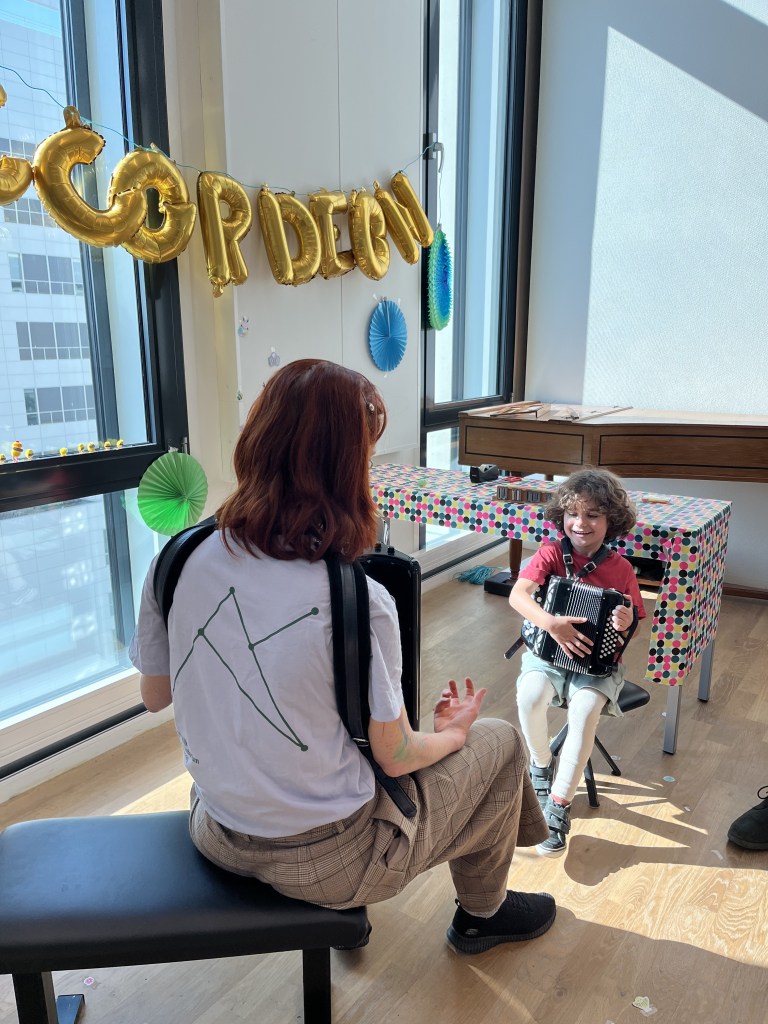
My son during the open day at KonCon.
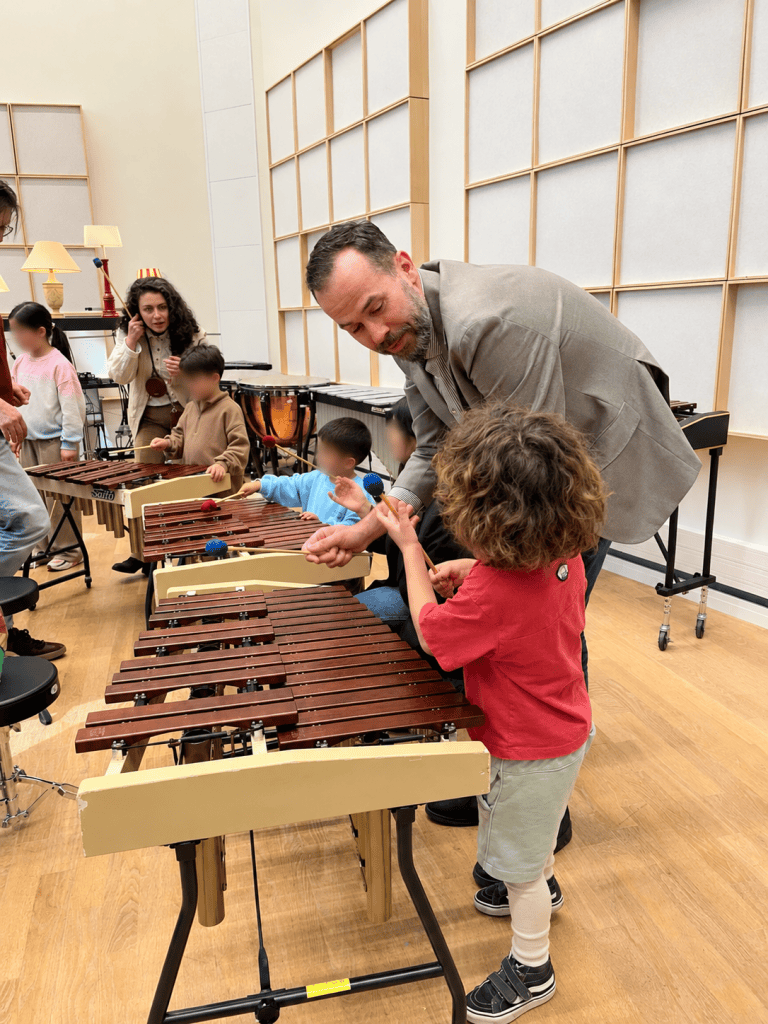
The music box.